
中国企业出海视角下的清真产业价值解析 An Analysis of the Value of the Halal Industry from the Perspective of Chinese Enterprises' Overseas Expansion
2026年7月19日
清真产业的真正价值远不止一张认证证书,而是一套连接食品安全、供应链管理、市场信任和区域消费的重要体系。中国企业进入马来西亚及东盟市场,不能只关注"证书怎么办",更需对原料来源、供应商追溯、生产设备交叉污染、仓储物流区分管理、标签文件、内部管理体系及市场渠道进行系统性梳理。这是一项系统工程,而非简单办证——正确的进入顺序是先判断产品、再梳理供应链、再评估管理体系、再研究认证路径、最后才做渠道推广。 The true value of the Halal industry extends far beyond a single certificate of compliance — it is an integrated system linking food safety, supply chain governance, market trust and regional consumption. Chinese enterprises entering Malaysia and the wider ASEAN market cannot focus solely on "how to obtain the certificate"; they must systematically address raw material sourcing, supplier traceability, cross-contamination risks in production equipment, segregation capability in warehousing and logistics, labelling and documentation, internal management systems, and downstream channel acceptance. This is a systematic undertaking rather than a paperwork exercise. The correct sequence is: first assess product fit, then map the supply chain, then evaluate production and management systems, then study the certification pathway, and only lastly pursue channel and market promotion.
【导语 / Lead】
不少企业一听到"清真",首先想到的是认证。但清真产业的真正价值,远不止一张证书,而是连接食品安全、供应链管理、市场信任和区域消费的重要体系。
On hearing the word "Halal," many enterprises instinctively think of certification. Yet the real value of the Halal industry extends far beyond a single certificate — it is an integrated system linking food safety, supply chain governance, market trust and regional consumption.
中国企业研究马来西亚和东盟市场,很难绕开一个关键词:清真产业。
For Chinese enterprises studying the Malaysian and ASEAN markets, there is one keyword that is virtually impossible to avoid: the Halal industry.
但在实际交流中,很多企业对清真产业的理解还比较浅。有的企业认为清真只是食品标签,有的企业认为只要拿到一张证书就可以进入市场,还有的企业把清真简单理解为某一类宗教消费需求。
Yet in practice, many enterprises hold only a surface-level understanding of the industry. Some regard Halal as a mere food label; others believe that a single certificate is enough to access the market; still others narrowly interpret Halal as catering to a particular religious consumer demand.
这些理解都不完整。
These understandings are all incomplete.
清真产业背后,是一整套供应链管理体系。
Behind the Halal industry lies an entire supply chain management system.
对于食品、农产品、日化、餐饮、冷链、包装、检测、仓储物流等企业来说,清真产业关注的不只是最终产品,更关注产品从原料、生产、加工、储存、运输到销售的全过程。
For enterprises operating in food, agricultural products, daily chemicals, catering, cold chain, packaging, testing, warehousing and logistics, the Halal industry concerns not only the end product, but the entire journey from raw materials, production, processing, storage and transport through to sales.
企业如果想进入清真市场,需要思考的不只是"证书怎么办",还包括:
Enterprises seeking to enter the Halal market need to consider far more than "how to obtain the certificate," including:
原料来源是否清楚;
Whether raw material origins are clearly documented;
供应商是否可追溯;
Whether suppliers are traceable;
生产设备是否存在交叉污染风险;
Whether production equipment carries cross-contamination risks;
仓储物流是否具备区分管理能力;
Whether warehousing and logistics have segregation capability;
标签和文件是否符合要求;
Whether labels and documentation meet requirements;
内部管理体系是否能够长期稳定执行;
Whether internal management systems can be executed consistently over the long term;
市场渠道是否真正接受该产品。
Whether market channels genuinely accept the product.
清真认证是结果之一,但不是全部。
Halal certification is one of the outcomes, but it is not the whole story.
对中国企业而言,清真产业之所以值得研究,是因为它不仅关系到马来西亚本地市场,也关系到更广泛的东盟及国际清真消费市场。马来西亚在清真产业体系、市场认知和区域连接方面具备一定基础,中国企业则在生产制造、食品加工、农业装备、冷链物流、数字追溯和供应链组织方面具有优势。
For Chinese enterprises, the Halal industry is worth studying not only because of its relevance to the Malaysian domestic market, but also because of its connection to the broader ASEAN and global Halal consumer markets. Malaysia possesses a strong foundation in Halal industry systems, market recognition and regional connectivity, while Chinese enterprises hold distinct advantages in manufacturing, food processing, agricultural equipment, cold chain logistics, digital traceability and supply chain organisation.
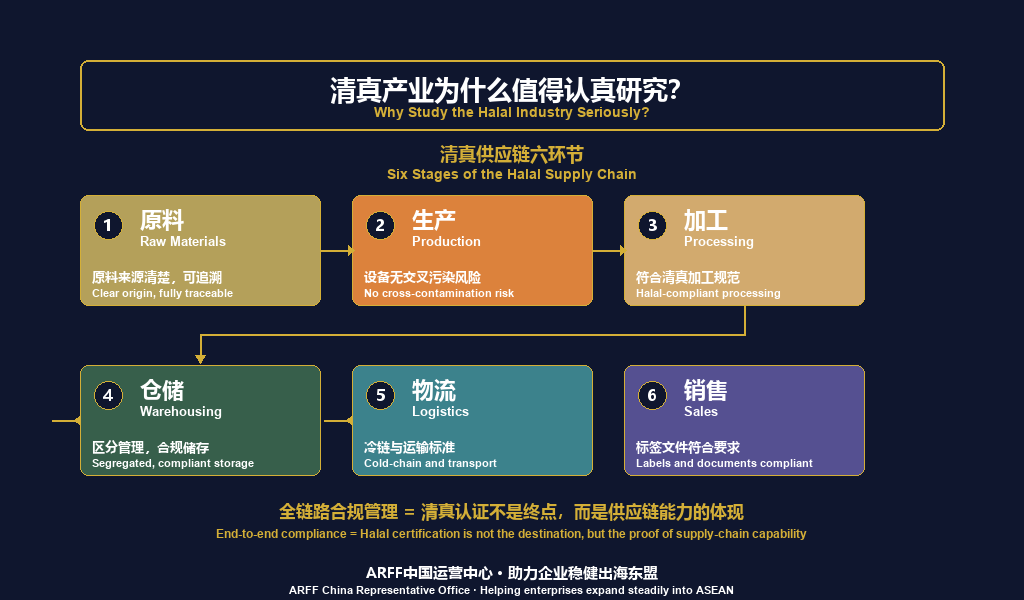
如果双方能力能够结合,就不只是做单个产品出口,而是有机会围绕清真食品、农产品加工、供应链服务、品牌运营和区域渠道建立更深合作。
If the strengths of both sides can be combined, the opportunity extends well beyond exporting individual products — there is scope to build deeper collaboration around Halal food, agricultural product processing, supply chain services, brand operations and regional channels.
但也必须提醒企业:清真产业不能急功近利。
But enterprises must also be cautioned: the Halal industry cannot be approached with a quick-win mentality.
如果企业只是为了营销概念去做清真,而没有真正建立供应链管理能力,后续很容易出现合规、质量和信任风险。
If an enterprise pursues Halal purely as a marketing concept without genuinely building supply chain management capability, it will subsequently face considerable compliance, quality and trust risks.
进入清真市场,正确顺序应该是:
The correct sequence for entering the Halal market should be:
先判断产品是否适合; First, assess whether the product is suitable;
再梳理原料和供应链; Then, map raw materials and the supply chain;
再评估生产和管理体系; Next, evaluate production and management systems;
再研究认证路径; Then, study the certification pathway;
最后才是渠道和市场推广。 Only lastly pursue channels and market promotion.
这是一项系统工程,不是简单办证。
This is a systematic undertaking, not a simple matter of obtaining paperwork.

【结语 / Closing】
清真产业不是一张证书,而是一套信任体系。
The Halal industry is not a certificate — it is a system of trust.
谁能把供应链管得更清楚,谁能把产品做得更稳定,谁能真正尊重当地市场规则,谁才有可能在清真市场走得更远。
Those who manage their supply chains most clearly, deliver the most consistent products, and genuinely respect local market rules will be the ones who go furthest in the Halal market.